
LEARN SOMETHING NEW
Therapy Blog for Orem, Spanish Fork & South Jordan
What It Means To Be Close – Understanding Relationships
What It Means To Be Close – Understanding Relationships
When we think about our social circles, one of the main ways we measure them is by how close we feel to someone. But what does it mean to be close? When understanding relationships through psychology, we describe four general levels of connection: stranger, acquaintance, casual friend, and close friend.
Changes in these circles—especially with close friends—can be one of the biggest sources of stress in life. Being aware of who fits into each circle helps us better understand and map out how to navigate changes in our relationships intentionally as they come up and is a core part of therapy.

The Four Levels of Connection
-
Strangers
This level is the least talked about since it includes people we don’t have any real connection with. Still, being mindful of how we interact with strangers and what feels comfortable for us can be helpful.
When we try to form new connections, we’re practicing the skills that move people from
this category into the next one.
-
Acquaintances
These are people we see or interact with regularly but don’t know deeply—coworkers, classmates, or extended family members we only see occasionally.
They’re familiar faces, but not people we typically turn to for emotional support. (Related Article: Seven Ways to Improve Your Relationships With Coworkers)
-
Casual Friends
Casual friends are people we share experiences or history with and see more consistently.
There’s comfort and some trust, but we usually don’t depend on them heavily for emotional or relational needs.
We may share parts of our lives, but we often keep deeper topics for those we’re closest to.
-
Close Friends
This is our most personal circle. Most people only need two or three close friends.
These relationships include trust, consistency, and often an unspoken sense of commitment. We depend on close friends to meet our primary relational needs—they’re the people we go to for support, share deeper emotions with, and prioritize when life gets busy. (Related Article: What Is Emotional Safety InA Relationship?).
For many individuals, one of these close friends will be their spouse or significant other. Goals in these relationships may be more specific than in their other close friends. In these relationships it is common to seek support through relationship counseling to build intentional patterns with your significant other. (Related Article: The Sound Relationship House: Build Love Maps)
When Social Circles Change
Changes in our close-friend circle can cause significant distress and can lead to questioning what it means to be close. When someone we rely on steps back or when dynamics shift, it can feel like we’re losing an important source of comfort or stability.
Being mindful of who fits into each circle helps us stay grounded during these transitions. It also allows us to be intentional about who we move closer to, so we can maintain strong connections and support throughout life.
Sometimes we realize someone in our close circle might not be ready for that level of relationship. In those moments, setting healthy boundaries and adjusting expectations can help and is a great topic to explore even for individuals in therapy exploring their relationships. (Relate Article: Communication Skills: Boundaries)
Moving them into a circle that better fits the current level of comfort and trust can protect both people from frustration or disappointment.
When Circles Don’t Match
Another source of relational discomfort is when there’s a mismatch in expectations. What does it mean to be close if only one of person feels that way or wants the closeness? These Relationships patterns can be very difficult to understand and navigate.
For example, if you treat an acquaintance like a close friend—sharing too deeply or trusting too quickly—it can create confusion or discomfort. The other person might not be ready for that level of openness, and it can lead to misunderstandings.
Recognizing these different levels of connection helps us manage expectations and protect our emotional energy. It also helps us grow relationships at a pace that feels healthy for everyone involved. (Related Article: Self Care & Relationships)
Finding Balance
Our social circles are always changing. People move, life gets busy, and relationships evolve. (Related Article: Therapy for Teens in Utah: Coping with Change)
Being mindful of these circles doesn’t mean keeping emotional distance—it means understanding who fits where and what kind of support we can give and receive.
When we recognize these dynamics, we can respond with more grace when relationships shift and invest our time and energy in the connections that matter most.
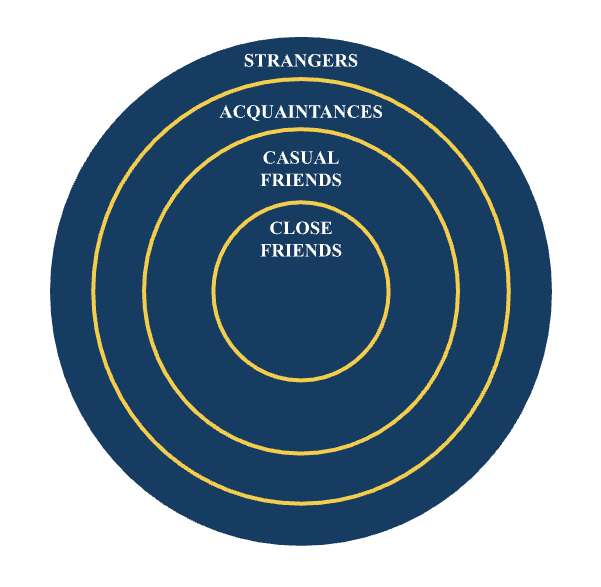
Here is a common diagram used to map out where people we see fall within our social circles. Fill it in with the names of the people you know, and plan time to review it with a therapist to explore patterns and support you in finding empowerment to manage your social circles in a way that builds positive living.